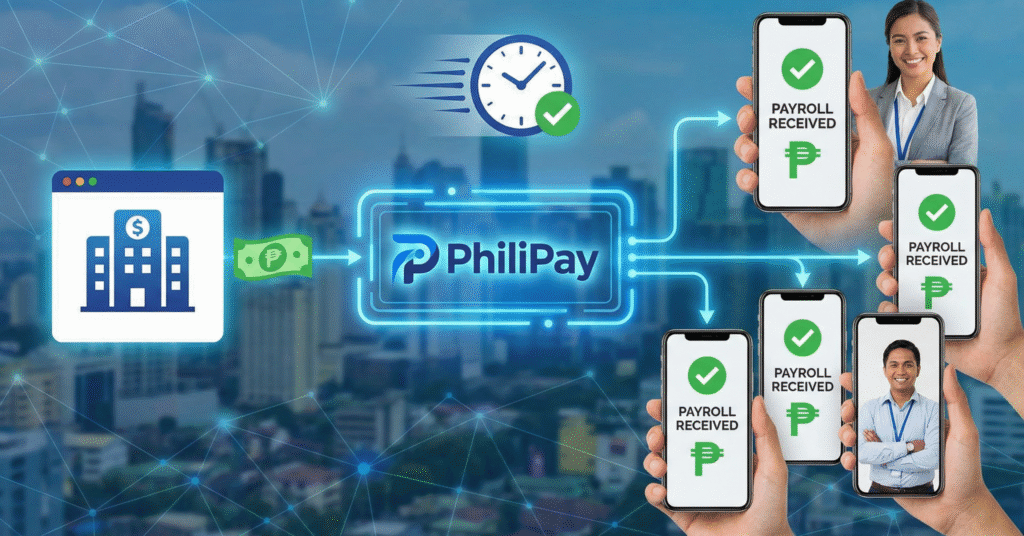
Payroll delays Philippines are more than just an inconvenience — they are a serious operational and legal risk that can erode employee trust, damage your employer brand, and even expose your business to labor code violations. Whether you are running a growing SME in Makati, managing a distributed workforce across the Visayas, or handling contractor payments for a BPO operation in Cebu, consistent, on-time payroll is non-negotiable. The good news? PhiliPay’s modern payment infrastructure is purpose-built to eliminate payroll delays for Philippine businesses of every size.
In this guide, we break down exactly why payroll delays happen, what the real cost is to your business, and how PhiliPay’s ecosystem — from automated Mass Payouts to seamless API integration — gives you the tools to pay your team on time, every time.
Table of Contents
Why Payroll Delays Are a Growing Problem for Philippine SMEs
The Philippines has one of Southeast Asia’s most dynamic labor markets, with over 11 million Filipinos employed in the formal private sector and millions more in the informal and freelance economy. Yet despite a booming digital economy, payroll delays in the Philippines remain a persistent and costly challenge.
Several structural factors contribute to this problem:
- Fragmented banking infrastructure that slows inter-bank transfers, especially outside Metro Manila
- Manual, spreadsheet-based payroll systems prone to human error and processing backlogs
- Cut-off time restrictions imposed by traditional banks on same-day or next-day transfers
- Multi-branch workforces where employees are distributed across regions with different banking preferences
- High percentage of unbanked or underbanked workers, particularly in rural provinces and in industries like agriculture, construction, and retail
According to the Bangko Sentral ng Pilipinas (BSP), nearly 52% of Filipino adults remain unserved or underserved by formal financial institutions (BSP Financial Inclusion Report). This means that for many Philippine employers, even having a payroll system is not enough — you need a system that reaches every employee, banked or not.
Payroll delays in the Philippines are not simply a technology problem. They are a systemic challenge that demands a modern, locally-adapted solution.
The Real Cost of Late Payroll: Beyond the Fine Print
Many business owners underestimate what a delayed payroll cycle truly costs. The consequences extend far beyond a disgruntled workforce.
Legal and Regulatory Exposure
Under the Philippine Labor Code (Presidential Decree No. 442), employers are legally required to pay wages on time and in full. Failure to do so can result in complaints filed with the Department of Labor and Employment (DOLE), penalties, and in severe cases, criminal liability. A single payroll dispute can trigger a full labor audit — a distraction no growing business needs.
Employee Attrition and Productivity Loss
Research consistently shows that pay reliability is among the top three factors influencing employee retention. When workers cannot count on their salary arriving on schedule, they begin looking elsewhere. In a competitive labor market like the Philippines — particularly in BPO, retail, and manufacturing sectors — replacing a single mid-level employee can cost ₱50,000 to ₱120,000 in recruitment, onboarding, and lost productivity.
Reputational Damage
In the age of Glassdoor, LinkedIn, and Facebook groups for job seekers, a reputation for late payroll spreads fast. Filipino candidates actively share employer reviews, and a pattern of payroll issues can make recruitment significantly harder and more expensive.
The business case for solving payroll delays is clear. Now let’s look at how PhiliPay’s infrastructure makes it possible.
How PhiliPay Infrastructure Prevents Payroll Delays
PhiliPay is a BSP-regulated digital payment ecosystem designed specifically for the Philippine market. Unlike generic global payment platforms, PhiliPay was built with an intimate understanding of local financial realities — the unbanked workforce, the archipelago’s geographic complexity, and the compliance requirements of doing business in the Philippines.
At the heart of PhiliPay’s payroll solution is a trio of powerful capabilities:
- Mass Payouts for simultaneous multi-recipient disbursements
- A dedicated Business Account for centralized fund management
- Open API integration that connects PhiliPay directly to your existing HR and accounting software
These are not standalone tools. They form a unified payroll infrastructure that eliminates the bottlenecks, manual errors, and banking limitations that cause payroll delays in the Philippines.
5 Seamless Ways to Eliminate Payroll Delays Using PhiliPay
1. Automate with Mass Payouts {#mass-payouts}
The most direct answer to payroll delays is automation — and PhiliPay’s Mass Payouts feature is the most powerful tool in your payroll arsenal.
Instead of processing individual transfers one by one (or relying on a bank’s batch upload system with its rigid cut-off windows), Mass Payouts allows you to disburse salaries to hundreds or thousands of employees simultaneously, in a matter of minutes.
Here is what makes it a game-changer for Philippine employers:
- Multi-network disbursement: Send funds to GCash, Maya, bank accounts, and e-wallets in a single batch
- Scheduled payroll runs: Set your payroll to execute automatically on the 15th and 30th — or any schedule your business requires
- Real-time confirmation: Every transaction is tracked and confirmed, so you know exactly who has been paid and who has not
- Bulk CSV upload: Simply upload your payroll file and let PhiliPay handle the rest
👉 Explore PhiliPay Mass Payouts and streamline your payroll today
For businesses managing payroll for 50, 500, or 5,000 employees, Mass Payouts eliminates the manual processing time that is the #1 cause of payroll delays.
2. Centralize with a PhiliPay Business Account
One of the most underappreciated causes of payroll delays is fragmented fund management. When payroll funds sit across multiple bank accounts, are subject to holding periods, or require multi-step approval processes, delays become inevitable.
A PhiliPay Business Account gives you a single, centralized hub for all your payroll funding needs:
- Pre-fund your payroll wallet in advance to ensure funds are always available when payroll runs
- Separate payroll funds from operational cash for cleaner accounting and audit trails
- Manage user access so your HR and finance teams can collaborate without risking unauthorized transactions
- View complete transaction histories for every payroll cycle — essential for BIR compliance and internal audits
By centralizing your payroll funding in a dedicated PhiliPay Business Account, you remove the dependency on external bank processes that so often introduce delays.
👉 Open your PhiliPay Business Account and take control of your payroll
3. Integrate via API for Real-Time Payroll Processing
For businesses with more complex payroll needs — particularly those using HR platforms like Sprout HR, PayrollHero, or custom ERP systems — PhiliPay’s open API integration is the most powerful solution available.
Instead of exporting payroll data, manually uploading it to a payment platform, and waiting for processing, API integration allows your payroll software to trigger disbursements automatically the moment payroll is approved.
The practical benefits are significant:
- Zero manual data entry between your HR system and payment execution
- Real-time status callbacks that update your HR records as soon as each payment is confirmed
- Conditional payroll logic that can handle overtime, deductions, and bonuses without manual recalculation
- Reduced error rates — because human re-entry of payroll data is eliminated entirely
This level of automation is what separates forward-thinking Philippine businesses from those still struggling with payroll delays caused by manual processing.
According to a Fintech News Philippines analysis of enterprise payment adoption, companies that integrate payment APIs into their core business systems report up to 80% reduction in payroll processing time (Fintech News Philippines).
4. Support Unbanked Employees with Alternative Disbursement
Here is a payroll challenge that most platforms ignore entirely: what do you do when a significant portion of your workforce does not have a bank account?
For Philippine employers in retail, manufacturing, agriculture, and construction, this is not a hypothetical. It is a daily operational reality. Sending payroll to an employee without a bank account forces employers into costly, time-consuming, and insecure alternatives — cash disbursement via manager, money remittance centers, or petty cash, all of which create delays and compliance risks.
PhiliPay solves this by enabling disbursements to e-wallets and mobile money accounts, including:
- GCash — the Philippines’ most widely used mobile wallet
- Maya (formerly PayMaya) — widely adopted among younger workers
- Other BSP-licensed e-money institutions (EMIs)
Your unbanked employees simply need a smartphone and a registered mobile wallet to receive their salary on time — no bank account required. This means zero employees left behind on payday, regardless of their banking status.
This approach directly aligns with the BSP’s National Strategy for Financial Inclusion (NSFI), which prioritizes expanding digital payment access to unserved and underserved Filipinos.
5. Monitor Every Transaction with a Live Dashboard
Payroll delays are sometimes not discovered until an employee calls HR asking where their salary is. By that point, the damage — to morale, to trust, to your employer brand — has already been done.
PhiliPay’s real-time transaction dashboard gives your finance team complete visibility into every payroll disbursement as it happens:
- Live payment status tracking — see which transfers are completed, pending, or failed in real time
- Instant failure alerts — if a disbursement fails (due to an incorrect account number or a recipient account issue), your team is notified immediately so corrections can be made the same day
- Exportable reports for payroll reconciliation, BIR filings, and internal auditing
- Multi-user access controls so different team members see only the data relevant to their role
This level of transparency transforms payroll from a stressful, opaque process into a fully visible, auditable workflow — one that your finance team can monitor and resolve proactively rather than reactively.
BSP Compliance and Payroll Security with PhiliPay
When you are disbursing payroll at scale, security and regulatory compliance are not optional. They are foundational.
PhiliPay operates under the regulatory framework of the Bangko Sentral ng Pilipinas (BSP), ensuring that every transaction processed through the platform adheres to Philippine financial regulations. This includes:
- Anti-Money Laundering Act (AMLA) compliance for all fund movements
- Data Privacy Act of 2012 adherence for the protection of employee financial data
- KYC (Know Your Customer) verification for all account holders
Your employees’ salary data and your business’s financial records are protected under PhiliPay’s enterprise-grade security protocols. For full details, you can review PhiliPay’s Privacy Policy and Terms and Conditions.
This regulatory alignment is especially important as the BSP continues to tighten oversight of digital payment platforms in 2025, following the implementation of enhanced EMI regulations and the expansion of the PESONet and InstaPay networks.
Choosing a BSP-regulated platform like PhiliPay is not just a compliance checkbox — it is a risk management decision that protects your business.
Case Study: How an SME Transformed Its Payroll Process
To illustrate the real-world impact of PhiliPay’s infrastructure, consider a hypothetical but representative scenario based on common challenges faced by Philippine SMEs.
The Business: A mid-sized retail company with 280 employees across 12 branches in Metro Manila and Cavite.
The Problem: Payroll was processed manually using a combination of spreadsheets and individual bank transfers. Every 15th and 30th of the month, the HR and finance team spent two full days processing payments — and still regularly missed the cut-off, resulting in delays of 1-2 business days for employees at smaller branches.
The PhiliPay Solution:
- The company opened a PhiliPay Business Account and pre-funded it five days before each payroll run
- HR uploaded a single CSV payroll file to the Mass Payouts dashboard
- PhiliPay disbursed all 280 salaries simultaneously — to bank accounts, GCash, and Maya wallets — in under 15 minutes
- The finance team monitored all confirmations in real time through the dashboard, identifying and resolving two failed transfers within the same hour
The Result: Payroll processing time dropped from two days to under one hour. Zero late payments were recorded in the following six months. Employee satisfaction scores in HR surveys improved noticeably, with pay reliability cited as a top positive factor.
This is the practical power of modern payroll infrastructure built for the Philippines.
Frequently Asked Questions
Is PhiliPay suitable for small businesses with fewer than 20 employees?
Absolutely. PhiliPay’s Mass Payouts feature scales to any workforce size, from 5 employees to 5,000. Small business owners benefit particularly from the time savings and the elimination of manual bank transfer processes.
Can PhiliPay handle payroll for employees with different banks or e-wallets?
Yes. PhiliPay supports disbursement to multiple banks, GCash, Maya, and other BSP-licensed e-wallets in a single payroll batch. You do not need to sort employees by their banking preference — PhiliPay handles the routing automatically.
How do I ensure my payroll data is secure on PhiliPay?
PhiliPay is a BSP-regulated platform that adheres to Philippine data privacy laws and employs enterprise-grade encryption. Your payroll data is protected at every stage of the transaction. Review the full Privacy Policy here.
What if a payroll transfer fails?
PhiliPay’s dashboard provides real-time failure alerts so your team can identify and resolve failed transfers immediately — on the same day payroll runs. This prevents the situation where employees are unaware they have not been paid until days later.
Can I schedule payroll in advance using PhiliPay?
Yes. PhiliPay allows you to schedule payroll runs in advance, so your disbursements execute automatically on your designated payroll dates — even if your finance team is occupied with other tasks.
Is PhiliPay compliant with DOLE and BIR payroll requirements?
While PhiliPay is a payment execution platform rather than a full payroll management system, its transaction records and exportable reports provide the documentation needed to support DOLE compliance and BIR payroll audits.
Final Thoughts & Next Steps
Payroll delays in the Philippines are a solvable problem — but solving them requires moving beyond outdated manual processes and traditional banking limitations. The businesses that thrive in 2025 and beyond will be those that invest in modern payroll infrastructure designed for the realities of the Philippine workforce: geographically dispersed, partially unbanked, and increasingly expectant of real-time digital experiences.
PhiliPay’s ecosystem — combining Mass Payouts automation, a centralized Business Account, open API integration, and real-time monitoring — gives Philippine businesses of every size the tools to pay their teams on time, every time, with full compliance and transparency.
The cost of delayed payroll — in legal risk, employee attrition, and lost productivity — far exceeds the cost of implementing the right solution. And with PhiliPay, the right solution is more accessible than ever.
💼 Ready to eliminate payroll delays for good? Join thousands of Philippine businesses already using PhiliPay’s secure, BSP-regulated infrastructure to process payroll faster, smarter, and with total confidence.
👉 Create your PhiliPay account today and run your first payroll in minutes.
PhiliPay is a BSP-regulated digital payment platform. All transactions are governed by our Terms and Conditions and Privacy Policy. For enterprise payroll solutions, contact our business team directly through philipay.ph.